


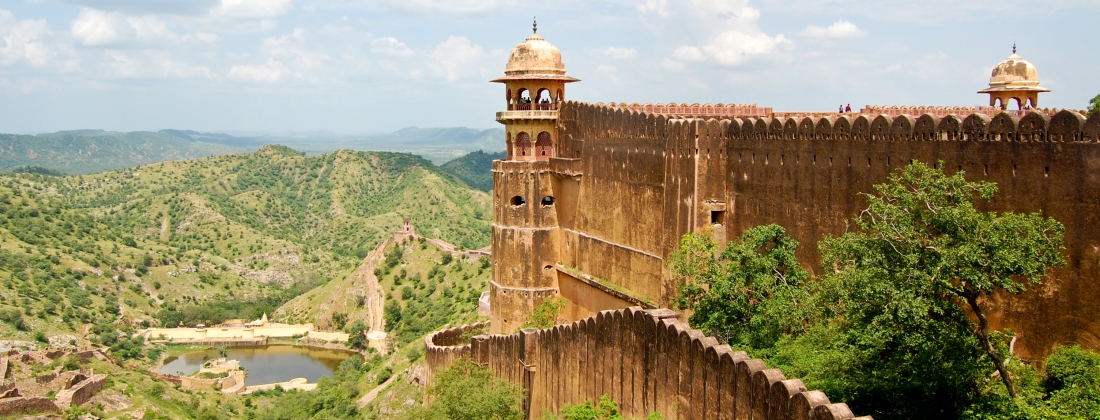
Discover Rajasthan I
15-day adventure trip in the land of kings & palaces – Cultural highlights in the realm of Rajput rulers, Maharajas and Mughal emperors
Fairytale marble palaces – Traditional havelis – Imposing fortifications – Impressive sanctuaries – Magnificent rocky and desert landscapes – Highlights of exquisite Mughal architecture
This 15-day adventure and cultural tour combines the exotic splendor and rugged natural beauty of Rajasthan with the world famous sites of the neighboring state of Uttar Pradesh. In each stage of this tour, you will discover the magic of a bygone era and experience why Rajasthan truly deserves the designation “the land of kings”. Historic fortifications and picturesque palaces of Rajput rulers alternate with important temple complexes and magnificent cities. Among the outstanding cultural highlights are the world famous Brahma temple of Pushkar and the “Pink City” of Jaipur, which puts every visitor under its spell with its magnificent temples, havelis and palaces. The legendary “Palace of Winds” is also located here. With the Taj Mahal and Fatehpur Sikri, India’s ‘lost capital’, the last part of the tour provides a glimpse into the imposing architecture of the north Indian Mughal era. A varied journey with many inspiring impressions!
The proposed itinerary is flexible and can be tailored to your needs in terms of content and schedule.
Delhi – Mandawa & Shekhawati region – Bikaner – Nagaur – Jodhpur – Udaipur – Chittaurgarh – Bundi – Pushkar – Jaipur – Bharatpur – Fatehpur Sikri – Agra & Taj Mahal – Sikandra – Delhi
Suggested Itinerary:
Day 1: Arrival in Delhi – Glimpses of the capital
 The Indian capital Delhi, the second largest city in the country after Mumbai, can be the starting or end point for tours in Rajasthan. The metropolis, with its astounding collection of temples, mosques, forts, former colonial buildings, densely populated residential areas and busy shopping streets, consists of two urban areas: Old Delhi and New Delhi. This makes it easier for visitors to find their way around the city. Built in the first half of the 17th century, Old Delhi served as the capital of the Mughal dynasty and is dotted with forts and mosques, such as the Red Fort, and the Jami Masjid. New Delhi is characterized by wide streets and embedded parks and was established in 1911 as the capital by the British. A much-visited hub is Connaught Place, with its cafes, restaurants and shops.
Day 2: Transfer to Mandawa – Attractions in the Shekawati region – Frescoed havelis of Marwari traders
 The Shekhawati region north of Jaipur has great scenic and cultural charm. The name of this desert border area dates back to the Rajput ruler Shekhaji Rao, who founded a principality here in the 15th century. The special attraction of this area is the frescoed architecture, the only of its kind in India. A considerable number of houses, palaces and monuments are decorated with elaborate murals in vivid colors. The themes comprise arabesques with flower patterns and birds, ethnic motifs and scenes from the Indian epics as well as designs with a European touch. Especially adorned with the detailed murals are the opulent residences and commercial buildings of the Marwaris, as the inhabitants of the region are called. The Marwaris came to considerable prosperity as enterprising merchants from 1770 to 1930, trading in gold, jewelry, carpets, spices and silk. By constructing spacious houses, the so-called havelis, they gave expression to their newfound status and tried to outdo one another. The magnificent havelis are privately owned and many are still inhabited. Sometimes, upon request, one can be granted a look at the beautiful interior of these houses.
Day 3: Transfer to Bikaner – Junagarh Fort – Spectacular fortress with palaces – Extravagant havelis
 Bikaner was founded over 500 years ago by Rao Bhikaji, a descendant of the founder of Jodhpur. Located on a trade route, the city was an important trading center in medieval India. Its more than 7 km of circular ramparts with bastions protected its inhabitants from outside attacks. The tourist highlight of Bikaner is the well-known Junagarh Fort, dating back to the 16th century, with its various palaces and its Anup Mahal, richly decorated with stucco, glass, mirror and glass work. The old city of Bikaner provides insights into the architecture of the extravagant, multi-storey havelis, the spacious traditional houses built around a courtyard. The Karna Mata Temple, 33 km away, is dedicated to Karnaji, a mystic of the 15th century, who is regarded as the incarnation of the Goddess Durga.
Day 4: Transfer to Jodhpur – En route visit to Nagaur – Mosques and palaces
 Nagaur used to be a small town protected by massive ramparts. Great mosques and palaces adorned with murals bear witness to a past imbued with Muslim and Hindu influences. Late January or early February, Nagaur hosts a week-long cattle fair with a folk festival character, attracting thousands of visitors and stock breeders from the area every year. The market is regarded as a smaller version of the famous Pushkar Camel Fair. Colorful costumes, an exotic festive atmosphere, traditional folk customs and camel races provide insights into the cultural diversity of Rajasthan.
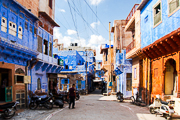
Day 5: Tour of Jodhpur – Glimpses of the fascinating blue city
 This city, which became well known through its eponymous tight-fitting trousers, worn by riders, was built on sandy terrain near the Thar desert. It was once a center for the rulers of Marwar. Life in Jodhpur revolves around Mehrangarh Fort in the historic city center, a tourist attraction with palaces, museums, warehouses, hotels and shops, offering colorful Rajasthani attire decorated with mirrors and embroidery. The bazaar has separate areas for different lines of trade. Locally produced goods range from batiks to dolls and silver jewelry. In Rajasthan, Jodhpur is also known as the blue city. The historic city center, in particular, is dominated by the color blue. The custom traces its origin to houses that were painted this color by Brahmins. In the course of time, this preference has spread further and today, the color blue can even be seen on mosques and other buildings. The spectacular fort, which offers a beautiful view of the city, includes Jhanki Mahal, Moti Mahal, Phool Mahal and other palaces adorned with decorative latticework.
Day 6: Transfer to Udaipur – En route visit to the magnificent Jain temple of Ranakpur
 Ranakpur, located in a remote valley, boasts one of the largest and most important Jain temples in India. The site, known for its grandiose architecture and lavish ornamentation, was built in 1439 and is considered a masterpiece of the West Indian architectural style. Some parts of the temple are two or three stories high. The roof is designed with five Sikharas (tower-like structures in the temple architecture of North India). The interior features 29 halls. Some of them are octagonal, while others extend over several floors. They are supported by a total of 1444 pillars, each one with a unique ornamental design. The lacy decorations on the vaulted roof are of exquisite quality and combine the highest aesthetic standards with understated elegance. The temple is dedicated to Adinath, the first of the 24 Tirthankaras (“ford-Maker”) of the Jain religion. Its four-faced image can be viewed in the sanctum of the Chaumukha shrine. The Jains, who meditate in the open hall before the statue, do not revere him as a God but hold him up as an example. In the vicinity of the complex are two smaller Jain temples, dedicated to the Tirthankaras Parshvanath and Neminath, and a Hindu temple dedicated to the sun god Surya. The Parshvanath Temple has a statue of the 23rd Tirthankara made of black stone, with a multi-headed cobra towering over his head. The walls are richly decorated with sculptures, including delicate erotic figures. Especially noteworthy in the Surya Narayana Temple is the portrayal of the sun god Surya in his carriage, drawn by seven horses.
Day 7: Tour of Udaipur – Fairytale marble palaces – Evocative splendor at Lake Pichola
 The city of Udaipur at Lake Pichola expresses the magic of Rajasthan in particularly picturesque and evocative ways. On the banks of the artificial lake, marble palaces rise up, a brightly glistening white in the sunlight. Further sumptuous palaces, converted to luxury hotels, are located on two islands. The crowning glory of the palaces in Udaipur is the City Palace, in which the full splendor of the Orient is on display. Until 1956, it served as the seat of government for the Maharanas of Mewar and it is the largest palace complex in Rajasthan. The walls of the residence of the former ruler are adorned with mosaics opulently decorated by peacock motifs. The floors are inlaid with precious tiles. The palace is crowned by balconies, towers and domes and offers fabulous panoramic views from its upper terraces and roof gardens. Much of the complex is now a museum with a representative collection of miniatures, mirror work and ornamental tiles. Below the palace entrance is the impressive Sri Jagdish Temple, the largest Jain temple in Udaipur. We also recommend a visit to Shilpgram, an area outside the city center designated for the promotion of traditional arts and crafts. The exhibition is not limited to Rajasthan, but extends to folk art from Gujarat, Goa and Maharashtra.
Day 8: Transfer to Bundi – En route visit to Chittaurgarh – Stronghold of the Rajput warrior
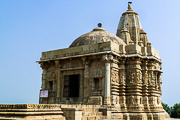 Chittaurgarh is the largest historic fort in all of India. A sightseeing visit gives an insight into the indomitable fighting spirit and pride of the legendary Rajput warrior. Many thousands of soldiers lost their lives in the defense of this fort and many Rajput women committed Jauhar here, the ritual mass suicide in the holy fire to avoid dishonor at the hands of the enemy. The climb up to the impressive fort goes via a winding road, which used to be guarded and defended by seven fortress gates. Each turn of the ascending path comes with a legend of a brave warrior who gave his life here in defense of the fort. A special attraction of the complex is the Vijaysthambha, the stone “Tower of Victory”, covered with exquisite sculptures of Hindu gods.
Day 9: Tour of Bundi – Palace complex with Elephant Gate & Taragarh Fort – Transfer to Pushkar
The town of Bundi is located in a charming narrow valley next to a steep hill. A palace complex dating from 1600 can be found on a lake with several small islands. To access it, one passes through the impressive Hathi Pol (elephant gate), over the short, steep ramp leading up to it. The complex contains several smaller palaces. Several of the 18th century murals of the Chitra Mahal are considered to be particularly typifying examples of traditional Rajput painting. Towering over the city is the massive Taragarh Fort. Built in the mid-14th century, this quadrangular fort with large corner bastions served as the ruler’s residence until the end of the 16th century. With proper footwear, it can be reached in 20 minutes in a challenging climb. The eastern side is dominated by a gate with high ramparts and battlements; the main gate to the west is flanked by octagonal towers. The central feature of the fort is the Bhim Burj tower, the platform of which once served as the base for the Garbh Ganjam, the big gun. From the fort, one has a wonderful panoramic view of the city, the palace and the surrounding hills.
Day 10: Visit to the Brahma temple of Pushkar – Insights into the ritual tradition of Hinduism – Transfer to Jaipur
 The pilgrim town of Pushkar is among the most important religious sites in India, with winding streets that run through a narrow valley dominated by impressive cliffs. Its primary attraction is the only temple in India dedicated to Brahma, the creator of the world. The 14th century shrine, which is visited by pilgrims throughout the year, has a special sanctity as tradition holds that Brahma took incarnation at this spot. According to legend, the temple originated from a lotus flower that the Hindu god, riding on the wild goose Hamsa, dropped to the floor while looking for a suitable place to perform a sacrifice. Apart from the Brahma temple, there are about 400 smaller temples in the city. On the 52 ghats on Pushkar Lake, pilgrims take their ritual baths in one of India’s most sacred water bodies. Another attraction is the Camel Fair. Held at the end of October or the beginning of November, the Pushkar Mela, a camel market and popular festival type event, hosts over 200,000 visiting tourists, pilgrims, farmers, camel breeders and traders. The place takes on a colorful carnivalesque atmosphere for the duration of the festival.
Day 11: Tour of Jaipur – Palaces, temples and havelis in the “Pink City” of Rajasthan
 Jaipur was founded in 1727 and laid out with a remarkable architectural perfection that never ceases to amaze. The name “Pink City” refers to the old town, situated in the north-eastern part of the city, featuring gorgeous palaces as well as a number of temples whose architecture presents the styles of several centuries. Instead of narrow, winding streets, we find straight and spacious streets here that cross at right angles. The pink color with which the walls are painted is the outstanding feature here. In Rajasthan, pink is considered the color of hospitality. The traditional houses are called havelis and are 3-to 5-storey buildings set around a shaded courtyard. The bazaar has separate areas for different lines of trade. The famous jewelers of Jaipur are also found here, offering the best selection of semi-precious stones and silver jewelry. Among the more important attractions are the city palace of the ruler Jai Singh, the observatory and the Ram Niwas garden. An absolute highlight is the Hawa Mahal, or “Palace of Winds”, built in 1799 to enable the women of the court to see the street processions without being seen themselves. Although the building was fitted with a five-storey façade, in most places it is not more than one room deep. With the decorative latticework on the windows and balconies, the design of the facade is very appealing.
Day 12: Transfer to Bharatpur – Lohagarh Fort & Keoladeo National Park
Among the other attractions in and around Bharatpur are the Lohagarh Fort and the Keoladeo National Park. The Lohagarh Fort, a massive fortress from the 18th century, is also called the Iron Fort because of its impregnable strength. Several attacks by the British Army were successfully repulsed here, and in 1805 the British had to withdraw after a six-week siege because of severe losses. Lohagarh Fort was built by Maharaja Suraj Mal, who also founded the city. The interesting remains of three palaces (Kishori Mahal, Mahal Khas and Kothi Khas) can be found within the fortress walls. Both the impressive interior design and the exquisite tile patterns in the flooring represent a great combination of Mughal and Rajput architectural style elements.
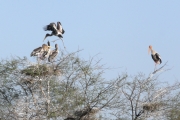 The Keoladeo National Park used to be known as the Bharatpur Bird Sanctuary and was reserved for hunting by the royal family. With its more than 400 species of birds, the National Park is today rated highly by ornithologists. But the area is well worth a visit, even for the casual visitor. Several species of herons have their habitat here, such as the purple heron, the grey heron and the Indian pond heron. Other bird species present include the painted stork, Eurasian spoonbill, white ibis and grey pelican. From October to March, the area is home to about 130 species of migratory birds that arrive from distant lands to winter here. The park is also inhabited by wild boars, mongooses, deer and antelope.
Day 13: Transfer to Agra – En route visit to Fatehpur Sikri – The forgotten city of Mughal Emperor Akbar
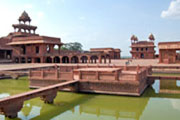 Fatehpur Sikri, a former capital of the Mughal Empire, lies 40 km to the southwest of Agra in Uttar Pradesh and due to its location and importance, is often an integral part of a trip to Rajasthan. Fatehpur Sikri was constructed between 1569 and 1585 by the Mughal Emperor Akbar but was abandoned as soon as 1600 due to persistent water shortages. The city, a UNESCO World Heritage Site, presents itself with an impressive combination of Islamic and Hindu style elements. Within the royal palace is the spacious Diwan-i-Am, a courtyard for public audiences, and next to it rises the Diwan-i-Khas, the area for private audiences, a two-storey building with corner kiosks. Inside is a single room with a circular throne platform from which Akbar led discussions with followers of various religions, seated hidden behind ornate partitions. The foot of the throne’s pillar is decorated with Islamic, Hindu, Christian and Buddhist motifs in four sections. Other attractions include the Dawlat Khana (the artistically designed private rooms of the ruler), the Palace of Birbal, his Grand Vizier, the Jami Masjid, the grave of Sheikh Salim Chishti and the 54 m high Buland Darwaza, erected in 1576 to commemorate the victory over Gujarat. The Palace of Jodhbai, which dominates the harem complex, also has a blend of Hindu and Islamic style elements and is decorated with the tulip motif characteristic of Fatehpur Sikri.
Day 14: Tour of Agra – Agra Fort and Taj Mahal – The White Pearl of India
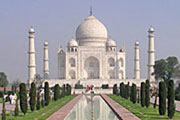 Featuring the Taj Mahal, Agra is an impressive tourist landmark. The largest part of the city is on the western bank of the Yamuna. The Taj Mahal itself forms the center around which the city spreads out. Towards the west lies the Agra Fort, right on the river bank. The Mughal Emperor Akbar started with the construction of the massive complex in 1565. Many historical events that eventually led to the construction of the Taj Mahal took place here. From the fort, you can see the Taj Mahal, in the middle of its gardens, surrounded by walls. It was constructed over a period of more than 20 years by the Mughal Emperor Shah Jahan as a tomb for his wife Mumtaz Mahal. The tomb is located on a platform surrounded by four minarets, at the northern end of gardens decorated in Charbagh style. The central dome is 55 m high. The entire complex looks particularly impressive from close quarters, and visitors admire both the grandeur of the overall impression and the extraordinary detail of its sculpture, further accentuated by the flower-shaped inlays of semi-precious stones. And within are the tombs of Mumtaz Mahal and Shah Jahan, crafted from marble and set with exquisite inlays. The Taj Mahal certainly warrants more than one visit, with its appearance changing with different lighting conditions during the day.
Day 15: Transfer to Delhi – En route visit to Sikandra – Return home or travel onwards
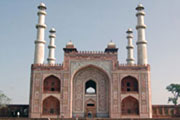 The small town of Sikandra is in the Indian state of Uttar Pradesh, 10 km north of Agra, on the road to Delhi. Due to its ideal location, it is often included in tours around Rajasthan. The main attraction of Sikandra is the grandiose tomb of the Mughal emperor Akbar. The mausoleum, commissioned by the ruler three years before his death, was completed in 1613 by his son Jahangir. Situated in a quiet garden, the architectural design of the tomb is an excellent example of the combination of different styles. The magnificent main entrance, the use of ornamental motifs and Persian calligraphy, the decorative cutout patterns of the walls and windows, the artistically designed garden and the four multi-storey minarets are testament to the prevailing Islamic influence. The remains of the ruler are kept in a simple marble sarcophagus downstairs.
In the evening, a transfer is made from Delhi to the train station or airport to return home or travel onwards.